Пропись · handwriting
Russian cursive: how to write and read Russian handwriting
The short answer
Russian cursive is the joined handwriting Russians use every day: the same 33 letters as print, almost all written in one stroke and linked to the next letter. Most letters look like their printed or italic forms, but a few do not (т is written like m, д like g, и like u, г like z, and л and м start with a small hook), so learn those first.
Trace Russian cursive on screen, like tracing paper
Lay the tracing paper over the copybook and write over the gray model with your finger, a stylus or the mouse. Start at the green dot and follow the arrow: the stroke to write next is highlighted. Trace letters or whole words, or type your own word, then make the model fainter until you can write it on your own.
привет hi
Words
Letters
Printed and cursive letters: the full table
Tap any cursive letter to watch it being written, capital first, then lowercase. Capitals reach nearly twice the height of lowercase letters; most of them do not join the next letter.
| Printed | Cursive | Sound | How to write it | Joins |
|---|---|---|---|---|
| А а | Trace А а | a, as in father | Start at the top right of the oval, go round counterclockwise, then come down the right side and finish with a hook. | enters at the top; leaves from the line |
| Б б | Trace Б б | b | Write an oval like о, then carry the stroke up above the line and sweep it to the right. | enters at the top; pen lifts after it |
| В в | Trace В в | v | Go up into a tall loop, come down to the line, then make the round belly and finish in the middle. | enters at the top; leaves from the middle |
| Г г | Trace Г г | g, as in go | A small hook, a curve over the top, then down to the line and a tail to the right.Looks like z. | enters at the top; leaves from the line |
| Д д | Trace Д д | d | An oval like а, then a stroke down below the line with a loop to the left.Looks like g. | enters at the top; leaves from the line |
| Е е | Trace Е е | ye, as in yes | Start in the middle, loop up and round to the left, and finish at the line. | enters at the middle; leaves from the line |
| Ё ё | Trace Ё ё | yo, as in yonder | Write е, then add the two dots when the word is finished. | enters at the middle; leaves from the line |
| Ж ж | Trace Ж ж | s in pleasure | Three parts: a curve like ), a straight downstroke, then a curve like ( with a tail. | enters at the top; leaves from the line |
| З з | Trace З з | z | A top curve like the number 3, then the lower curve continues into a loop below the line. | enters at the top; leaves from the line |
| И и | Trace И и | ee, as in see | Down, round at the bottom, up to the top, then down again with a tail.Looks like u. | enters at the top; leaves from the line |
| Й й | Trace Й й | y, as in boy | Write и, then add the small curved breve on top. | enters at the top; leaves from the line |
| К к | Trace К к | k | A straight downstroke, then from the top right a small curve in to the middle and out to the line. | enters at the top; leaves from the line |
| Л л | Trace Л л | l | Start with a small hook at the line, go up to the top, then down with a tail.Starts with a hook. | starts with a hook at the line; leaves from the line |
| М м | Trace М м | m | Like л with a second downstroke: hook, up, down, up, down.Starts with a hook; т does not. | starts with a hook at the line; leaves from the line |
| Н н | Trace Н н | n | A downstroke, back up to the middle for the crossbar, then the second downstroke with a tail. | enters at the top; leaves from the line |
| О о | Trace О о | o, as in more | An oval, counterclockwise from the top right, closed with a small loop at the top. | enters at the top; leaves from the top |
| П п | Trace П п | p | A small hook, down, then back up and over in an arch and down with a tail.Looks like n. | enters at the top; leaves from the line |
| Р р | Trace Р р | rolled r | Down well below the line, back up, then round the bowl to the right.Looks like p. | enters at the top; leaves from the line |
| С с | Trace С с | s | A small hook at the top, then round to the left like c. | enters at the top; leaves from the line |
| Т т | Trace Т т | t | A hook, then three downstrokes joined by arches at the top, like m.Looks like m; many write a bar over it. | enters at the top; leaves from the line |
| У у | Trace У у | oo, as in boot | Like и, but the second downstroke runs below the line into a loop.Looks like y. | enters at the top; leaves from the line |
| Ф ф | Trace Ф ф | f | A small oval on the left, a tall stroke through the line, then an oval on the right. | enters at the top; leaves from the line |
| Х х | Trace Х х | kh, as in loch | Two curves back to back: ) then (, touching in the middle. | enters at the top; leaves from the line |
| Ц ц | Trace Ц ц | ts | Like и, then a small tail below the line on the right. | enters at the top; pen lifts after it |
| Ч ч | Trace Ч ч | ch, as in chair | A short curve down from the top, round and up, then a downstroke with a tail. | enters at the top; leaves from the line |
| Ш ш | Trace Ш ш | sh | Three downstrokes joined at the bottom.Looks like w; some write a bar under it. | enters at the top; leaves from the line |
| Щ щ | Trace Щ щ | long soft shch | Like ш, with a small tail below the line on the right. | enters at the top; pen lifts after it |
| Ъ ъ | Trace Ъ ъ | hard sign (no sound) | A short stroke along the top, a downstroke, then a small round belly. | enters at the top; pen lifts after it |
| Ы ы | Trace Ы ы | y, a deep i | A soft sign ь followed by a separate downstroke. | enters at the top; leaves from the line |
| Ь ь | Trace Ь ь | soft sign (no sound) | A downstroke and a small round belly at the bottom, like b. | enters at the top; pen lifts after it |
| Э э | Trace Э э | e, as in pet | A curve like a reversed c, then the short bar in the middle. | enters at the top; pen lifts after it |
| Ю ю | Trace Ю ю | yu, as in you | A downstroke, a short bar at the middle, then an oval. | enters at the top; pen lifts after it |
| Я я | Trace Я я | ya, as in yard | A small oval at the top, a hook down to the line, then a downstroke with a tail. | starts with a hook at the line; leaves from the line |
The letters that look misleading
These letters trip up readers of English, because in cursive they look like a different Latin letter. Learn this table and most handwriting stops being a puzzle.
| Cursive | Russian letter | Looks like | How to tell |
|---|---|---|---|
| т | m | Cursive т is written like an m. Many people put a bar over it (т̄) so it is not taken for ш. | |
| ш | w, ɯ | Three downstrokes, like w with sharp tops. Some people put a bar under it (ш̱). | |
| и | u | Two downstrokes joined at the bottom, like u. Its sound is “ee”. | |
| л | ʌ | Always starts with a small hook at the line, then one downstroke. | |
| м | m | Like л with a second downstroke: a hook, then two humps. Do not confuse it with т, which has no hook. | |
| д | g, ∂ | An oval with a tail going below the line, like g; some people write it like ∂ with a loop upwards. | |
| г | z, 2 | Looks like a z or a 2. It is the sound g. | |
| з | 3, ʒ | Like the number 3, with a tail below the line. | |
| п | n | Like n. Printed п is a “Π”, but handwritten it is round on top. | |
| в | b | A tall loop and a round belly, like a b. The sound is v. | |
| б | 6, δ | Like the number 6 with the top swept right. The sound is b. | |
| у | y | Like y, with the loop below the line. The sound is “oo”. | |
| р | p | Like p. The sound is a rolled r. | |
| е | e | Like e. The sound is “ye”. |
How the letters join
Cursive is fast because the pen rarely leaves the paper. These are the rules a Russian copybook teaches, with the joins drawn in red so you can see them.
1. Most letters join at the line
Finish a letter with a small upward tail; the tail becomes the stroke that starts the next letter.
2. Ovals are entered over the top
For а, о, д, с, я and ф, bring the joining stroke up and over to the start of the oval, then go round counterclockwise.
3. о and в end high
These two finish near the top of the line, so the next letter is joined from the top, not from the line.
4. л, м and я start with a hook
After о or в, which end high, you have to come back down to the line to make the hook: the classic trap in ол, ом and оя.
5. Some letters do not join forward
After б, ь, ъ, э, ю, ц and щ, and after most capitals, lift the pen and start the next letter fresh.
6. Dots and breves come last
The two dots of ё, the breve of й and the crossbars are added once the word is finished.
Real words in cursive
The same words in print and in cursive, as a Russian teacher would write them on the board.
| Cursive | Printed | Meaning |
|---|---|---|
| приветprivet | hiTrace привет | |
| спасибоspasibo | thank youTrace спасибо | |
| пожалуйстаpozhaluysta | please; you’re welcomeTrace пожалуйста | |
| здравствуйтеzdravstvuyte | hello (polite)Trace здравствуйте | |
| до свиданияdo svidaniya | goodbyeTrace до свидания | |
| хорошоkhorosho | good, fineTrace хорошо | |
| мамаmama | momTrace мама | |
| чайchay | teaTrace чай | |
| борщborshch | borschtTrace борщ | |
| кошкаkoshka | catTrace кошка | |
| собакаsobaka | dogTrace собака | |
| люблюlyublyu | I loveTrace люблю | |
| ёжикyozhik | little hedgehogTrace ёжик | |
| школаshkola | schoolTrace школа | |
| РоссияRossiya | RussiaTrace Россия | |
| МоскваMoskva | MoscowTrace Москва |
Read a short handwritten note
A postcard from Moscow, handwritten. Try to read it before you open the printed version.
Show the printed text and translation
Дорогая Аня!
Привет из Москвы.
Погода хорошая,
мы много гуляем.
Вчера были в Кремле.
Скоро увидимся!
Целую, Маша
Translation: Dear Anya! Greetings from Moscow. The weather is good, we’re walking a lot. Yesterday we went to the Kremlin. See you soon! Love, Masha
Practice reading real handwriting
Real handwriting is quicker and less tidy than the copybook. These words are written in an everyday hand: choose the printed word you see.
Answer
мир
Answer
тишина
Answer
лимон
Answer
учитель
Answer
жизнь
Answer
дом
Answer
шум
Answer
город
Printable practice sheets and poster (PDF)
Prefer pen and paper? The practice sheets have every letter, capital and lowercase, to trace and then copy on slanted copybook lines, followed by 16 common words. The poster shows the whole alphabet on one page. Both print on A4 or Letter.
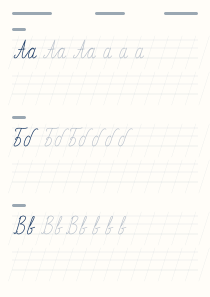 Download practice sheets (PDF)15 pages, A4 · 1.1 MB
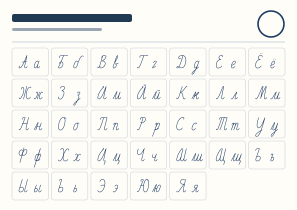 Download alphabet poster (PDF)1 page, A4 landscape · 0.3 MB
Can you type in cursive?
No. Keyboards type printed letters only; cursive exists in handwriting. “Cursive” fonts such as Marck Script imitate it for headings and invitations, but nobody types letters or messages in them.
To type Russian, add the Russian keyboard: on Windows in Settings → Time & language → Language & region, on a Mac in System Settings → Keyboard → Input Sources, on a phone in the keyboard settings. The standard layout is called ЙЦУКЕН after its top row; a phonetic layout puts я on Q and в on W if you do not want to learn new positions.
Questions people ask about Russian cursive
Do Russians write in cursive?
Yes. Children learn cursive in their first year at school from copybooks called прописи (propisi), and almost everything adults write by hand (notes, letters, school work, signatures) is in cursive. Block letters are used mainly on official forms.
Is Russian cursive hard to learn?
Writing it is not: most letters look like their printed or italic forms, and the rest follow a handful of rules. Reading is harder, because т, ш, и, л and м look like rows of similar humps and real handwriting drops detail. Learn the misleading letters first, then read whole words rather than single letters.
Why does cursive т look like m?
The handwritten т comes from an older form with three downstrokes, and Russian italic type copies it, so т in italic print looks like an m too. To avoid confusion with ш, many people put a bar over the т.
What is the “минимум” meme?
Written in cursive, минимум (minimum) is an almost unbroken row of identical humps: м, и, н, и, м, у, м. It is a joke about how hard Russian handwriting can be to read. The hooks at the start of each м and the crossbar of н are the clues.
Should I learn to write in cursive or just to read it?
Learn to read it whatever you do, because Russians write to each other in cursive. Writing it is faster than printing and is expected in Russian classes, but printed letters are always understood.
Is Ukrainian or Serbian cursive the same?
Ukrainian and Belarusian use the same handwritten forms, plus their own extra letters. Serbian and Macedonian cursive write several letters differently (for example т and п), and Bulgarian schools teach some shapes differently too.
How long does it take to learn Russian cursive?
If you already know the printed alphabet, a week of short daily practice is usually enough to write every letter, and a few weeks of reading real handwriting makes it comfortable. The practice sheets on this page are made for that.
